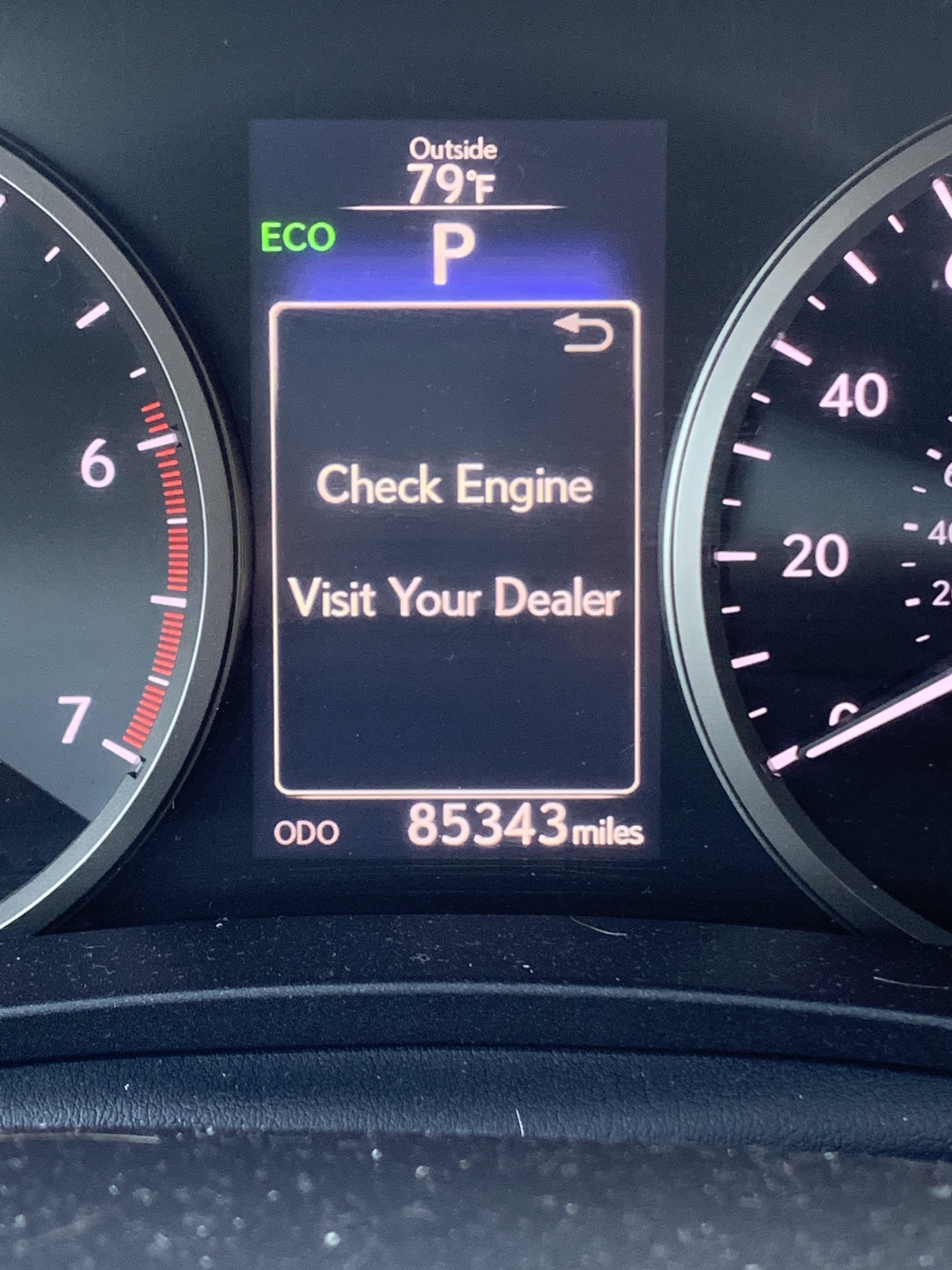
Check Engine – Visit Your Dealer
Toyota Hilux / Fortuner 1GD-FTV (GUN125) — Root Cause Analysis & Fixes
The "Check Engine – Visit Your Dealer" line on the MID is not a fault in itself. It is the cluster mirroring the amber MIL — the ECU has logged at least one confirmed emissions/driveability DTC severe enough to light the lamp. The MID gives you the symptom; the stored DTC gives you the cause. You cannot diagnose from the message text alone, and clearing it without finding the trigger just resets the clock until the next drive cycle.
Step 0 — Pull the codes before touching anything
- Scan with Techstream (or a capable tool — ThinkTool / MultiEcuScan / OBDLink). Generic OBD readers routinely miss the manufacturer P1xxx codes that matter here.
- Note status: current / pending / history. A history-only code that won't re-set is a different problem to a hard current code.
- Capture freeze-frame: RPM, calc load, coolant temp, rail pressure, boost, MAF, vehicle speed at the moment of the fault.
- Look for a theme. A pile of unrelated codes usually means a comms / ground / ECM issue — not ten separate failures.
Exact code-to-message mapping varies by market, emission spec (Euro/BS6) and ECU software version. Treat the lists below as the usual suspects on this platform, not gospel.
1 Injector correction / quantity learning (most common on the GD)
- Typical codes: P1601 (injector compensation / EEPROM), P1604, fuel quantity / drift-compensation faults.
- Cause: injector correction (ID/QR) codes not written, mismatched, or injectors worn enough that per-cylinder learning runs out of authority. Very common after an injector swap, ECU swap, or simply at 100k+ km.
- Fix: confirm correct injector codes are written for each cylinder, run the injector / quantity-learn routine, verify per-cylinder balance and idle correction in live data. If values are pinned at the rail, the injectors are the problem, not the code.
2 EGR system
- Typical codes: P0401 (flow insufficient), P0402 (flow excessive), EGR valve position faults.
- Cause: carbon fouling of the valve and intake is the classic GD failure — sticky/lazy valve, oily sludge in the inlet, rough idle, power loss, black smoke under load.
- Fix: pull the intake pipe, inspect for sludge, clean or replace the valve, check the cooler. Verify commanded vs actual EGR position in live data.
3 DPF system
- Typical codes: P2002 (efficiency below threshold), differential-pressure sensor circuit (P245x family), Δp out of range, regen duration/frequency faults, EGT sensor faults.
- Cause: short-trip / low-load duty preventing a passive regen, blocked Δp pipe (dusty carbon plugs the take-off), dirty/failed temp probes, or a genuinely loaded filter. Ends in limp mode if ignored.
- Fix: confirm coolant reaches full operating temp on normal driving; run a proper highway cycle or a tool-commanded regen; physically check the Δp pipe and temp sensors — a blocked sense line reads false and is a known trap on this engine. Replace the filter only once you've ruled out the sensing side.
4 Turbo / VNT / boost
- Typical codes: P0234 (overboost), P0299 (underboost), VNT/actuator control faults, P0107/P0108 (MAP), P0097/P0098 (IAT).
- Cause: sticking VNT vanes (soot), actuator/control fault, boost leak, or a sensor reading out of range. Overboost trips are frequently transient and clear after a key cycle.
- Fix: log requested vs actual boost, check the VNT actuator sweep, inspect intercooler piping/clamps for leaks, verify MAP/IAT plausibility against ambient.
5 Fuel supply / rail
- Typical codes: P0087 (rail pressure too low), P0088 (too high), SCV / supply pump faults, P0093 (large leak).
- Cause: failing SCV, weak supply pump, restricted filter, or air/leak in the low-pressure side.
- Fix: monitor commanded vs actual rail pressure under load, check SCV duty, inspect filter and feed. Low pressure under demand with high SCV duty points at the pump/SCV.
6 Glow plug / sensor circuits
- Typical codes: glow-plug circuit (P0380 / P067x), plus individual sensor circuit highs/lows.
- Cause: failed plug or relay, chafed harness, corroded connector.
- Fix: ohm the plugs, check the controller and harness. Usually a single-component repair.
Where SCR/AdBlue is fitted (emission-heavy variants), add the NOx / reductant family (P20xx / P2BAxx) — inducement runs on its own state machine, so it can sit behind a "visit dealer" message independent of the engine codes.
On a modified truck, a big share of these trace back to the mod, not a failed part:
- EGR blanked without addressing the flow monitor → P0401/P0402 once the ECU expects flow it can't see.
- Larger exhaust / decat altering backpressure and gas velocity → DPF temp/Δp logic upset, incomplete regen, P2002.
- Aggressive boost request or an intake change → transient overboost → P0234 limp.
- Injector swap with no correction codes written → P1601/P1604.
- Tune raising fuel or boost past a monitor left at OEM → the surveillance/plausibility path trips even though the headline map looks clean.
Bottom line
The MID message is a pointer, not a diagnosis. Scan → read freeze-frame → categorise → confirm with live data. On the 1GD the smart order of suspicion is: injector learning, EGR, DPF, boost/VNT, fuel supply, then sensors. Clear codes only after the root cause is confirmed and a full drive cycle completes clean — otherwise you're just buying a few kilometres before it comes back.